Enter any hardware store or check any e-commerce site for ceiling fans and you will be greeted by a wall of specifications like, wattage, sweep size, how many blades, star rating. Most consumers do not even look further than the single figure that serves as the answer to a question actually, how hard a fan will run: RPM. It is the most truthful test of a ceiling fan performance however it receives very little attention.
Here are some of the things you must know before you purchase a ceiling fan.
RPM- Revolutions Per Minute. In a nutshell, it informs you about the number of full rotations that the fan blade assembly is rotating in sixty seconds. The ceiling fan is set at 350 RPM: this means that the fan has 350 rotations per minute.
The rapid spinning blades move more air, but at some point. The form of the blade, the direction in which it slices the air, and the efficiency of the motor, all answer to the effectiveness with which that rotation will be converted into the cool breeze which you actually feel on your skin.
Read More: How to Install a Ceilling Fan
The standard ceiling fans available in India can have a range of 300 to 380 RPM as the highest speed rating. Budget fans are typically found at the lower and range at 300 to 320 RPM. Mid-range fans will normally reach 340 to 360 RPM with high-end models going up to 380 to even higher.
Mandatory energy efficiency ratings by the government (the BEE star system) have compelled manufacturers to achieve a greater airflow per watt which in fact has actually made the design of the fans significantly better over the last decade. Hence a 5-star fan running 350 RPM today would probably move more air than an older fan that was not rated running at the same speed.
What the majority of people are unaware of is that RPM that is printed on the box is at maximum regulator setting and no obstruction. Performance can differ significantly in the real-world where a furnished room is being used, a dirty motor is in use or where a fluctuating voltage supply is being used.
The normal ceiling fan of a high RPM normally runs around 380 RPM and some goes up to 400 to 430 RPM. The change is experienced instantly, particularly in rooms that are usually hot such as bedrooms facing the south or kitchen rooms.
The increased RPM implies increased noise levels when the quality of the motor is not available. A high-quality BLDC (Brushless DC) motor with high RPM spins quietly, and it consumes less energy. Comparing the RPM of the fans then, the combination of the RPM figure with the type of the motor will tell you much more than either of the two separately.
High RPM ceiling fans are also more likely to produce more airflow in the larger rooms where the air must travel a long distance before it reaches the occupants at the lower levels. The marginality between 340 and 400 RPM might be felt in small spaces. It is either comfort or frustration in a hall with the dimensions of 200 square feet.
Cooling by a ceiling fan is nearly the subject of air velocity to your skin helps cool down the room by increasing the rate of sweat evaporation.
That is the RPM speed of the fans is directly proportional to the effectiveness of the fan in the only job it has. When a fan operates at low RPM in a large room, it produces a slow movement of the air. A full throttle fan creates a wind-chill effect on the room at 34°C that may seem like 30°C or lower.
To facilitate room airflow circulation, it also allows the distribution of conditioned air to be more balanced during the period when an AC is operating using higher RPM. It maintains uniformity of temperature in the room. This is the reason why despite the presence of an air conditioning system, a ceiling fan with a good RPM will allow you to turn your AC thermostat up 2-3 degrees without losing any comfort - this will directly reduce electricity bills.
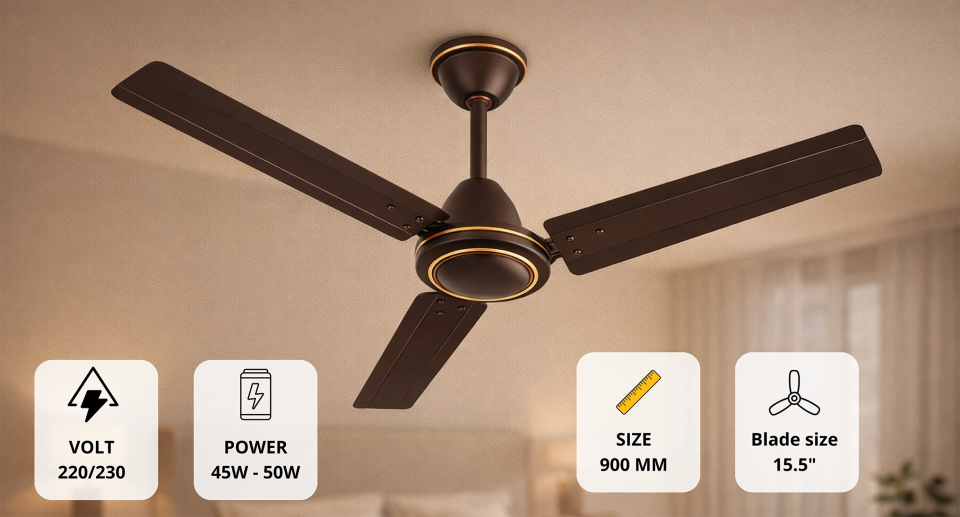
There are a number of factors that will make or make not the fan truly reach its rated RPM in your home.
Quality of motors: Both an induction motor and a BLDC motor can be similar in that they can run at 370 RPM, although the BLDC will be more stable in that speed regardless of changes in the voltage and will also do that at a much lower power consumption.
Blade Pitch: the angle in which blades are set up in it influences the amount of air that a single rotation moves. A higher pitch at the same RPM will increase the amount of air moved, but it will also require more power of the motor.
Fan Sweep Size: A 1200mm fan sweep with 350 RPM will move much more air than a 900mm fan at the same RPM, just due to the fact that the fan has more area covered in 350 RPM than in 900mm.
Capacitor: A direct relation exists between the quality of capacitor and startup torque and steady-state RPM. The most common cause of a slow running older fan is an old capacitor that is undersized or worn out and that replacing it is a highly inexpensive remedy that most homeowners never consider attempting.
Height of Installation: Mounting fans inside a ceiling more than 8-10 inches clearance the close proximity of fans to the ceiling means that air can no longer move freely above the blades and, although the motor may be turning rapidly, the fans can no longer produce maximum power.
To Find the Ideal Ceiling Fan RPM don't just go by the appearances and price as the only guidelines. Pull up the spec sheet. Note the fan RPM speed on full blast. Look at the CMM figure. Check whether it is a BLDC motor in case energy saving is a concern to you.
A good fan with 350-380 RPM and a CMM of above 210 is a good alternative in the case of most Indian homes. When you have a large area, a bad cross-ventilation system or a room that traps the heat, lean more towards the higher end or just settle on a specific high RPM ceiling fan model.
Ans: Yes. A higher ceiling fan RPM (revolutions per minute) means the blades rotate faster, which usually creates stronger airflow. However, cooling also depends on blade design and air delivery, not just RPM.
Ans: Common reasons include a weak or faulty capacitor, dust buildup on blades, a worn-out motor, low voltage supply, or an old regulator reducing the high speed fan RPM.
Ans: Yes, indirectly. A fan running at a higher RPM of ceiling fan may use slightly more power, but modern efficient motors (especially BLDC fans) maintain high speed while consuming less electricity.
Ans: RPM measures how fast the fan blades rotate, while CFM (cubic feet per minute) measures how much air the fan actually moves. A fan can have high RPM but still move less air if the blade design is poor.