
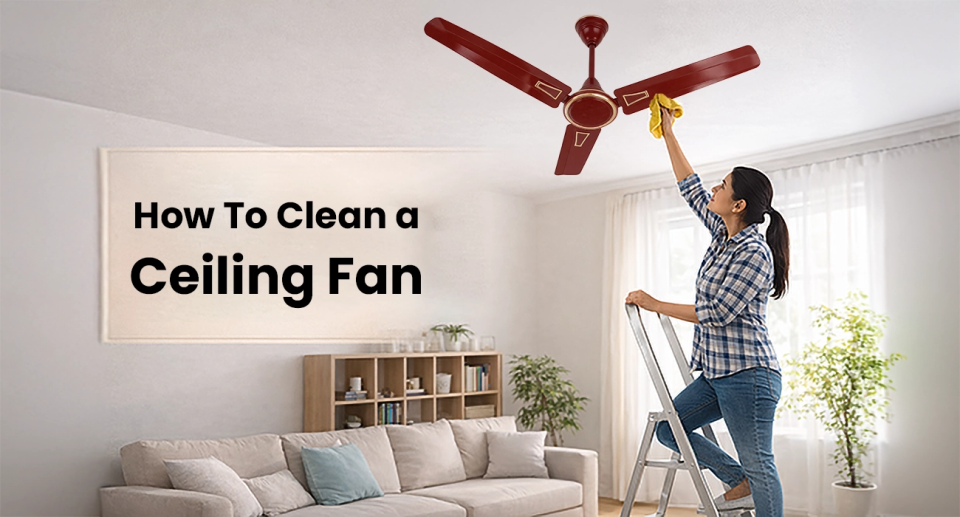
No one intends to ignore ceiling fan cleaning for almost half a year. It is simply coincidence-- one week passes into another, and before you know it the blades are all shaggy with a kind of grey wooly growth. The fan revolves, and still makes the right sound, so you leave it. Until you do look up. The thing is that here though a dirty ceiling fan is not only an eyesore. Being aware of how to clean a fan correctly - and the frequency with which you do so - actually does make a difference in the performance of your ceiling fan on a day-to-day basis. It conserves power, re-establishes airflow, and prevents the quiet distribution of a layer of dust across all surfaces of the room by your fan.
The relationship between dust and power use is something that is not considered by the majority of people. An average ceiling fan will consume around 50-75 watts in the normal operating conditions. A more ancient induction motor fan can reach 90 watts and above. By settling dust on the blades, this provides an unequal distribution of weight, and aerodynamic drag - the motor attempts to compensate by exerting additional effort to keep the same RPM. The consequence is an increase in energy demand of the same, or even worse, airflow. Give it some figures: a 75-watt fan that operates 12 hours per day consumes about 0.9 units of electricity per day. That would be approximately ₹270-300 a month per fan at average Indian tariff rates. Missing a few months of ceiling fan cleaning increases that usage ever higher, not drastically, but steadily. It is tons in a summer of many fans at work.
It is no less real the effect on air quality. The blades of ceiling fans in a bedroom circulate the air all night long and given that the blades were loaded with dust and dander, you are essentially running a low-grade distributor of allergens all night long. To anyone who is allergic or has respiratory sensitivity, the fan overhead would be the last thing that they would consider as an issue. Fan cleaning is not a perfectionist thing. It is convenient upkeep with quantifiable payoffs.
Read More: Ceiling Fan Wattage
Cleaning ceiling fans has a bad reputation because the usual method of cleaning them is swiping at the blades using a duster; this puts all of the dirt all at once down on beds, sofas and freshly cleaned floors. The whole idea is to contain, not move, the dust.
What you'll need:
Very important: Switch off the fan and allow the blades to stop. A moving blade will spread dust everywhere before you have even started, even at low speed.
Put the pillowcase over each blade one at a time and press it down in such a way that it touches both the top and bottom of the blade. Slowly draw it back-- the dust does not fly into the air, but settles up in the case. It is this one step that will make a job manageable or a half-hour mess.
Add a drop of dish soap to warm water. Wipe down each blade with a damp microfiber cloth not dripping wet, but merely damp. The most is used on the top surface, and it is not worth being in a hurry.
Clean the blade brackets that are attached to the motor. Dust accumulates in those joints and the majority lack them during cleaning fan exercises.
Wipe the motor housing softly, with care to the ventilation slots. These dissipate heat in the motor - blocked vents cause the motor to run warmer and consume more power.
Turn the fan off then dry all surfaces with a clean cloth and turn it back on.
Regular cleaning of your ceiling fans hardly ever needs a complete dismantling. With a normal ceiling height, a step stool will get you near enough to be effective.
In the case of high ceilings, it is worth purchasing extendable microfiber dusters that have the shape of U and encircle the blade on both sides. They are marketed with a specific instruction on how to clean a ceiling fan without having to go near it, and actually work, much better than attempting to lean a flat duster up the floor.
You can clean the entire piece of equipment without dismantling it, unscrew each blade separately (most have two to three screws), go to the sink, clean with soapy water, dry thoroughly, and screw back.
You don’t need fancy cleaners—simple household items do the job better and safer.
A fast wash only takes five to ten minutes and is all about maintenance such as the removal of dust on the surface before it solidifies into something heavier and more difficult to move. A once-a-month rhythm is reasonable with ceiling fans that are run on a daily basis during an Indian summer.
When the fan has been actually neglected, that is, a season or more without any thought given to it, a thorough cleaning of the fan is required. This involves removing the blades completely, cleaning brackets, wiping the vents of the motor thoroughly, and making sure that all the screws are tight. Blade screws are loosened by vibration and this is a direct cause of wobble.
In the majority of cases, the wobble can be corrected without any spare parts by a good deep clean, then ensuring that the blades are all at the same angle and height.
The traditional ceiling fans that have induction motors have a rating of 70-75 watts at full speed. With a 16-hour daily run time which is perfectly normal in warmer regions of India, it burns about 1.2 kWh per day, and costs about 7.8 per day. One fan will cost approximately 234 in a month. Three fans in a home translate to more than ₹700 a month on ceiling fans alone.
The accumulation of dust does not re-write those numbers to the exact same values, but it always shifts the consumption towards the larger half of the scale - and on older fans that are already operating inefficiently the effect is even more significant.
The most appropriate aspect of how to clean the fan discussions is this: even the fan with the highest rating and powered by BLDC and being rated as 5 stars does not work so well when its blades are full of dust. Productivity is planned at the plant. It is your responsibility to keep it in place
Avoid these common mistakes—they can quietly damage your fan and make future cleaning harder.
Ceiling fans are not very demanding. An adequate cleaning every few weeks, a more thorough one each season, a couple of minutes on the parts most skipped by people. That is literally all that is required to ensure a fan keeps running within the efficiency with which it was constructed-- silent, smooth and without the need to increase the electricity bill each month unnecessarily.
Ans: Yes, you can definitely do that by using an extendable duster or long-handled microfiber tool.
Ans: Less dust = smoother airflow and less strain on the motor leading to less power consumption.
Ans: Every 2–4 weeks; more often in dusty or kitchen areas.
Ans: Warm water, dish soap, microfiber cloth, or vinegar solution.
Ans: Use a soft brush, vacuum attachment, or compressed air. Safest cleaning method? Turn off power, support blades, and clean with a damp (not wet) cloth.