
Every year when summer comes, Indian households have the same moment as they get confronted with high electricity bills, which forces them to scratch their head and ask how am I getting such a high bill. Then the investigation begins. A/Cs? Water heaters? The refrigerator that's making a weird noise?
However, what everyone tends to ignore is the ceiling fans. They have been on from 12-14 hours a day and even as many as 16 hours on some days. Nobody thinks twice about them; they just keep turning.
The thing about ceiling fans is that their wattage adds up gradually, silently, and every month.
So, let’s talk about ceiling fan wattage, with no engineering jargon, just simple mathematics and actual numbers.
In simple language a watt is just a unit of power. Imagine it being like an appliance's appetite for power – its hunger for electric power for running. An example would be: If a fan is rated at 75 watts, then it uses 75 watts of electric energy every hour that it is on and this is the whole concept of wattage.
All that really matters is the wattage mentioned on each electrical device (for example, the wattage rating for a light bulb, charger, fan, etc). All electrical devices will use electric energy in relation to their wattage ratings – the higher the wattage = the greater the electric consumption = the more you will pay on your bill for it.
A ceiling fan watt rating can be found either on the motor housing of the fan or in its operating instructions but most people do not even check there for it which is understandable. Once you have checked and know it, you will start seeing things differently on your electrical bill.
Read More: What is Ceiling Fan RPM
Believe it or not this is the most commonly searched thing about ceiling fans. The answer will depend on both how big the ceiling fan is and what type of motor it has.
Most ceiling fans we find in India run from 50-75 watts. Many older ceiling fans (over 15 years old usually found in a family's ancestral home) use upwards of 80-90 watts due to very poor motor efficiency.
|
Sweep Size |
Room size |
Standard Fan (W) |
BLDC Fan (W) |
Units Per day (8 hrs) |
|
900 mm (3 ft) |
Small |
45–55 W |
22–28 W |
~0.4 units |
|
1050 mm (3.5 ft) |
Medium |
55–65 W |
26–32 W |
~0.5 units |
|
1400 mm (4.5 ft) |
Large |
75–90 W |
32–40 W |
~0.7 units |
|
1500 mm+ (5 ft) |
Commercial |
85–110 W |
38–50 W |
~0.85 units |
Let us understand the ceiling fan power consumption by using simple math.
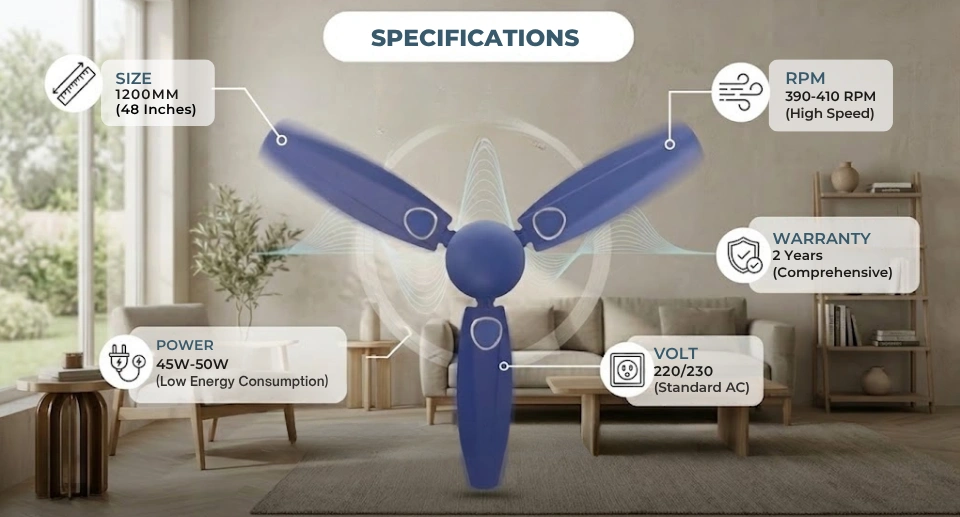
The fan in the Living Room is a standard 1200mm diameter ceiling fan rated at 75W. Assume that you use this ceiling fan for 8 hours a day (not continuously), that is, only during the morning, evening and night.
75 watts x 8 hours = 600 watt-hours = 0.6 kWh of consumption per day.
Multiply this by 30 days in a month: 0.6 kWh x 30 = 18 kWh/month, only for that one ceiling fan.
Now consider a typical house with 3 bedrooms. Assume that there is a ceiling fan in each room.
So, the power consumption for 1 month for 3 ceiling fans would be approximately 50 to 55 kWh. Assuming the cost of electricity to be ₹8 to ₹10 per unit (as per electricity/different tariffs charged by retailers), the monthly bill for 3 ceiling fans would be ₹400 to 550. Total cost per year = ₹4,800 to ₹6,600.
BLDC means Brushless Direct Current and the design of this form of motor is completely different from those of traditional motors, which utilize brushes and induction.
Standard ceiling fans use approximately 65-75 Watts of power for a 1200mm size unit; however, a BLDC fan in the same size range will only use between 28-35 watts. This is approximately half of what it takes to operate a standard ceiling fan.
In each case (i.e. same room, same amount of air movement [usually better, at the same time]), you will consume exactly HALF the amount of energy when using a BLDC fan than you would when using a standard ceiling fan.
However, the downside to this technology is that it will cost you up front; an average BLDC fan price falls anywhere from ₹2,500 to ₹5,000 or more depending on brand and features, and an average standard ceiling fan costs ₹1,200-₹2,000.
But what’s most important is this: if a BLDC fan saves 35 watts of electricity per hour, and is utilized 8 hours each day, that equates to 280 watt or .28 units of electricity saved daily. When calculated over the course of 30 days (assuming all days are equal), the total saved will be 8.4 units. In one year, that would equal approximately 100 units saved — per fan. If the cost of electricity is ₹8/unit, an annual savings of ₹800 would result for each BLDC fan purchased. Consequently, the price difference is paid off between years 2 and 3.
It is important to know some facts that affect power consumption.
Speed Setting: It is the number one thing to consider. Most fans have five speeds and if you run your fan on speed five all the time it will draw the most wattage and not be as efficient as if you were to run it on speed three throughout the evening in a non-peak summer and reduce your power consumption by 30-40%.
Motor Quality: The quality of the motor plays a huge part in this also, as an old motor that has not been properly maintained and has worn bearings will draw more electricity. That humming noise you hear from an old fan is because the motor is working extra hard. An old fan that wobbles and makes noises uses a lot of electricity quietly while you sleep.
Blade angle and Size: The angle of the fan blades and size of the fan blades will determine how much air the fan will move. The faster the fan has to turn the more electricity it will consume relative to the amount of air it is moving compared to a fan with a better blade pitch design.
Capacitor condition: The capacitor in the fan provides the proper amount of voltage to the fan for it to run at various speeds. A weak capacitor causes the fan to run slowly and also increases its current draw. If you think the fan has slowed down but the use has increased, you should have the capacitor checked. The cost to replace a capacitor will be about ₹50-₹100 and will likely solve both of the problems mentioned above.
Avoid leaving the fan on in empty rooms to save energy and extend its lifespan. It is not necessary to cool any empty spaces since only people need to be cooled by the air circulating from the fans.
If your ceiling fan is not already equipped with an electronic motor controller (or regulator), using one will save you significant amounts of energy.
Cleaning the blades of your ceiling fan every couple of weeks, you can improve the efficiency of the motor, and save yourself some money. The build-up of dust on the blades creates additional drag, causing the motor to use more energy than necessary.
When buying a new ceiling fan, check to see if it has been rated and how many stars it has received; the Bureau of Energy Efficiency has introduced a rating system for ceiling fans based on their efficiency (stars range from 1 to 5). For example, a 5-star rated fan is likely to be far more efficient than a fan that does not have a rating at all or has only been rated 1-star.
The standard wattage of a fan is between 50 to 75 watts. A BLDC fan operates at nearly 50 % less than this. Do the math for your house, and the savings you'll see each month during that period of time add up in a meaningful way.
If you're installing a replacement fan, or you're setting up a new area, choose a fan with a higher star rating or a BLDC fan. The upfront investment may be higher than a standard fan; however, they will eventually provide the payoff in savings, and they will continue to provide savings in the future.
Ans: A typical 75W ceiling fan running 8 hours uses about 0.6 units/day (0.075 × 8).
Ans: Yes. Higher speed = more power usage. Lower speed saves electricity.
Ans: Roughly ₹4–₹6 per day (depending on usage hours and electricity rate).