
Imagine you enter a showroom in need of a fan in your 12×12 bedroom and the salesman toss numbers at you: 1200 mm, 1400 mm, 48 inch and 56 inch — and you still don't know which one will cool the bedroom best! Most fan boxes have an indicated size, but no explanation of its effect on the air in your house: this guide fills that void.
The size of a ceiling fan is measured in millimetres and it is the diameter of the circle that the blades of the fan trace when they spin, not the length of an individual blade. If you get it wrong you either end with a fan that whispers instead of cools, or one that rattles your false ceiling every summer.
Blade size (or blade span) is the distance, measured straight across the spinning circle from tip to tip of three blades (or four) that are combined. It isn't twice the length of one blade, it isn't just the box size that some sellers simply round off.
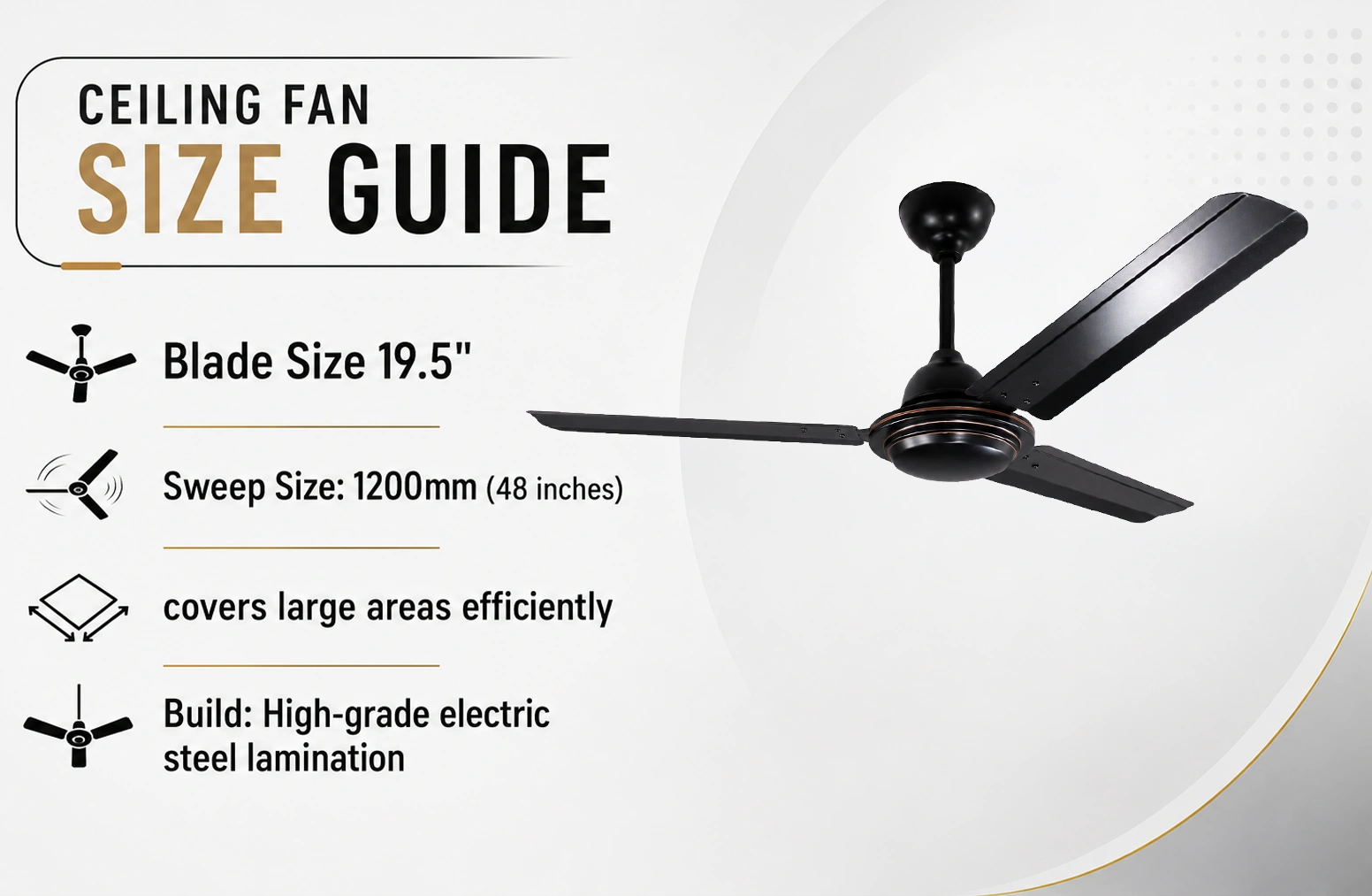
A 1200 mm fan sweeps a circle 1200 mm wide. It is this sweep area that is the ones actually pushing down the air into your room. Larger sweeps will move more air per rotation, but — and that's where most articles end — the size of the sweep is not the only factor that determines the quality of the fan's performance in terms of air flow.
Read More: Noiseless Ceiling Fan
Fan size refers from the centre-to-centre of the mounting point to the tip of the blade (then doubled or, more realistically, tip to opposite tip across the entire blade assembly. This is reported on the packaging by manufacturers in India as 'sweep' and always in millimetres.
This figure also determines the motor load. If you want to install bigger blades on a small motor you won't get the same rotational speed, as a larger sweep requires a stronger motor to achieve the same rotational speed.
In India, ceiling fans are offered in a limited number of standard ceiling fan sweeps: 900 mm, 1050 mm, 1200 mm, 1400 mm and on and off 1500 mm for big halls. The choice of 1200 mm is a default, as it is suitable for the average Indian bedroom/living room rather than some universal ideal.
The part that buyers seldom consider is the millimetre number which tells you the diameter, but doesn't tell you anything about the width of the blades, the angle of the blades or the torque of the motor (all of which affect actual air delivery). If two fans have the same sweep (i.e. 1200 mm), they may sound very different when operating under them.
Consider the size of your blade, based on the size of your room, ceiling fan with big blades is not a guarantee of better air flow. A 1400 mm sweep is not needed in a small utility room and a 900 mm fan will not provide enough power in a large open living/dining area, regardless of speed.
As a guideline, the blade sweeps the same width as the room, and then verifies the height of the ceiling. A fan that is 1050 mm or 1200 mm in width is normally more suitable for a narrow bedroom that is less than 10 feet wide, rather than a large fan that barely makes it over the walls.
Blades that are longer also throw out more air in a circle, and the length of the circle corresponds directly to how much air it throws out each revolution, which relates directly to air delivery; sometimes expressed as CFM (cubic feet per minute). Increasing the span of a blade does not linearly increase the airflow, because there are several factors that affect it, like tip speed, blade pitch, and motor RPM.
A 1200mm fan, from two different brands, can produce a significantly different air-flow. You could apply a higher blade pitch and more powerful motor windings to deliver more air on the same sweep, but at a lower efficiency, or you could coast along with less blade pitch and less powerful motor windings on the same sweep. The size of the blade is a good indicator, but not the complete answer.
If a fan is placed too close to the ceiling, it will not achieve an efficient flow of air, due to insufficient space between the fan blades and the ceiling for air to enter the fan. The mounting height should be approximately 8-9 feet from the floor and there should be a space of 10-12 inches between the tip of the blades and ceiling.
This is more challenging in rooms that have false ceilings. The false ceiling can take up a foot or more of vertical space which means the fan will be closer to head height which will decrease the effective air throw. If you have a false ceiling, make the sweep a little bigger than you normally would, or consult your electrician for fan models that are designed for low ceiling heights—this is precisely the problem they were created for!
The angle that each blade is tilted (pitch) is as important as the blade size, but few consumers inquire about it. A steeper pitch will chop up more air with each rotation, but require more power from the motor and introduce vibration if the motor is not designed for this pitch. There is a less air velocity per spin, but a flatter pitch is quieter, more efficient.
Therefore the comparison of a poorly designed 1400 mm fan with a well-designed 1200 mm fan will show that the latter will perform better.
|
Room Size (approx.) |
Recommended Fan Size |
Blade Span (mm) |
Ideal Ceiling Height |
Expected Airflow Coverage |
|
Small room (up to 100 sq ft) |
900–1050 mm |
900–1050 |
8–9 ft |
Single-zone, close coverage |
|
Standard bedroom (100–140 sq ft) |
1200 mm |
1200 |
9–10 ft |
Full room, even spread |
|
Large bedroom / living room (140–200 sq ft) |
1200–1400 mm |
1200–1400 |
10 ft+ |
Wide coverage, corners included |
|
Hall / open living space (200+ sq ft) |
1400–1500 mm or dual fans |
1400–1500 |
10–11 ft |
Requires two fans for even airflow |
If the fan is too large for a small room, it may not cool as effectively as a smaller fan since the fan blades are close to the walls and furniture and they do not provide a cool, smooth air flow but rather air turbulence.
One of the other errors that is overlooked is Furniture layout. However big the swing of a fan, it will not cover an area above a wardrobe or tall bookshelf. With open floor plans, a different approach is necessary — and it's often better to have two fans that are a bit smaller, but farther apart.
Another factor that might influence buyers' perceptions is RPM, where they believe higher RPM equals greater cooling capacity. It doesn't. High RPM fans with a poor pitch angle or design will be weaker than slower BLDC ceiling fans with efficient blade pitch angle, as airflow is created based on RPM, pitch angle and fan blade geometry, not just RPM.
Place the fan beneath the existing fan or the location where you are going to install the fan and measure across from one tip of one blade to the tip of the opposite blade. If it is a three blade fan, measure from the tip to the centre then multiply by 2 (no exact opposite blade).
Always refer to the sweep number on the sweeper's box as that is the actual sweep number of the manufacturer and what you need to refer to when you're making your purchase.
The size of the blade in millimetres is to start with and not the end. Pay attention to the number on the box after you have matched the sweep to the width of your room, taken into account the loss of ceiling space (false ceiling), and investigated the pitch of the blades and the quality of the motor. If the ceiling fan is mismatched with a larger ceiling fan, it will cost a lot less to run a well matched BLDC ceiling fan, but with a slightly smaller sweep size that will often outcool a mismatched ceiling fan.
When you are preparing to buy a fan this season, first measure your room to make sure the fan you are considering buying is appropriate, then you can shortlist fans by sweep size and finally, compare the motor specifications of the fans you are considering.
Ans: Yes. The right blade length improves airflow and makes a room feel cooler.
Ans 1200 mm to 1400 mm ceiling fan is generally ideal for a 16×16 ft room.
Ans: Measure the distance from the tip of one blade to the tip of the opposite blade (blade span).
Ans: A1200 mm or larger** ceiling fan is recommended for effective airflow.
Ans: Millimetres provide a standard, accurate way to compare fan sizes across different brands.