Almost every day we use the ceiling fan without giving it a second thought, but what makes it spin? Ceiling fans are one of the most popular home appliances in India, whether it's hot summer days in Delhi or humid nights in Mumbai. Have you ever thought about what makes those blades spin after spin?
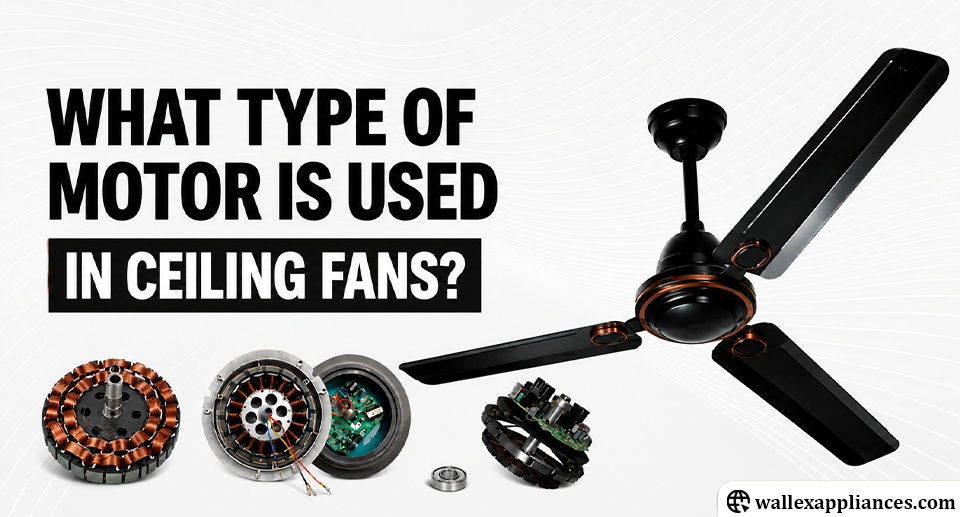
The simple answer is that traditional ceiling fans have a single-phase induction motor and energy efficient ceiling fans feature a BLDC (Brushless Direct Current) motor. The difference between these two can help you select the appropriate fan, save money on your electricity bills and make your purchase decisions more intelligent.
The motor is the most important part of any ceiling fan. It has a very simple but crucial task: to transform the electrical energy into rotational mechanical energy that powers the fan blades to move air around the room.
The quality and type of motor have an impact on:
Air Flow Efficiency — Volume of air moved by a fan for each watt of energy consumed.
Noise Level: Whether the fan is quiet or hums
Life Span: The expected lifespan of the fan under normal use conditions.
Power Consumption: This is a measure of the amount of electricity that it uses every month.
The ceiling fan motor type is even more important in India where the cost of electricity is a top priority.
Read More: Ceiling Fan Wattage
Single-Phase Induction Motor (Specifically Permanent Split Capacitor (PSC)) is the most widely used motor in the conventional ceiling fan in India.
It is so easy to use, inexpensive and dependable that it has been the industry standard for decades. The basic components work together in the following manner:
|
Component |
Function |
|
Stator |
The stationary outer part that creates a magnetic field using AC supply |
|
Rotor |
The inner rotating part that responds to the magnetic field and spins |
|
Capacitor |
Helps create a phase shift to start the motor and maintain smooth rotation |
|
Rotating Magnetic Field |
Generated by the stator to keep the rotor turning continuously |
Let’s have look at the type of motor used in ceiling fan
It operates on the principle of electromagnetic induction, the stator induces current in the rotor, which in turn creates another magnetic field and the interaction of these two fields causes the rotor to move.
The PSC motor is basically a standard single phase induction motor, modified to be more refined. It has a capacitor permanently connected in series with a stator winding and it does not connect to the windings during start-up.
This design improves:
Brushless Direct Current (BLDC) is the name given to this type of driving system. Even though it's called BLDC, the fans are still powered by AC power, with the motor controller within the fan converting the AC to DC power using electronics.
Unlike traditional induction motors, BLDC motors use electronic commutation instead of physical brushes or electromagnetic induction. Permanent magnets on the rotor interact with electronically controlled stator coils, driving rotation with very little friction or energy loss.
Operating efficiency: 26-35 watts (as opposed to 60-80 watts for induction motors)
Remote settable — Most BLDC fan is remote and timer controlled
Inverter-friendly - can efficiently function with the use of home inverters during power outages
Low Noise: Electromagnetic hum and vibration are not heard at all.
Wi-Fi or app compatible: Can be controlled via the Internet or an application.
BLDC fans use as much as 60-65% less power than the conventional induction motor fans. If a fan is used in the house thrice with 10 hours usage per day, the electricity bill can be reduced by ₹3000-₹5000 per year by using BLDC.
There is of course no single answer: depending on your priorities and use the best motor type is different.
Best for Budget Buyers: If it is the initial cost that counts, then the traditional induction motor fans (PSC type) are still the most suitable. They are easily obtainable, in hundreds of styles, and will last for years, if properly maintained.
Best for Energy Savings: BLDC motor fans are undoubtedly the best and most cost effective for long-term savings. While they cost more up front, they will pay for themselves in 1-2 years' time due to their lower electricity costs.
Power Cut Areas: BLDC fans are specially built to function efficiently in the home inverter.
Traditional ceiling fans are equipped with single-phase induction motors and the most popular is the P.S.C (Permanent Split Capacitor) induction motor in India. These motors are low cost, long lasting and can be easily maintained.
BLDC motors are now used by the majority of high-end fans in modern times, which provides a significantly superior energy efficiency, noiseless running, compatibility with inverter and smart home integration. As the cost of electricity keeps going up and houses with inverters are becoming common in India, BLDC technology is rapidly gaining momentum.
With Indian homes becoming more and more smart and energy-efficient, knowing what type of motor is utilized in a ceiling fan isn't simply an engineering topic; it's a practical choice for a more informed purchase.
Ans: Most traditional ceiling fans in India use a single-phase induction motor, specifically a Permanent Split Capacitor (PSC) motor, because it is reliable, durable, and cost-effective.
Ans: A BLDC (Brushless DC) motor is the most energy-efficient option. It consumes up to 60–65% less electricity than conventional induction motors while delivering similar airflow.
Ans: Most smart and remote-controlled ceiling fans use BLDC motors because they support electronic controls, remote operation, timers, and smart home integration features.