
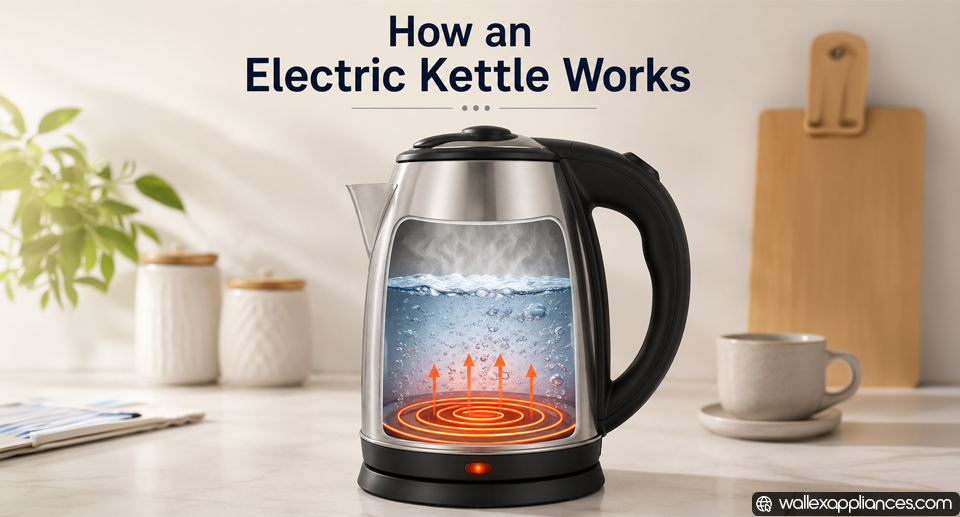
With the electric kettle just press the switch and watch the magic unfold, the kettle clicks itself off automatically at the end of ninety seconds to three minutes — no watch needed, no risk of boiling over, no watcher to be kept in check. That little automatic click is the result of a series of automatic, electrical, mechanical and thermal components. And after taking a look at what's contained inside, boiling water doesn’t feel like magic rather a neat little piece of engineering. In this article we will explain to you about various parts and functions of an electrical kettle.
Main parts of the kettle include the thermostat, on/off switch, kettle body, kettle lid, handle, indicator light, power base with electrical connector, sole plate (or base assembly), and heating element, and water filter in the spout. They can heat up the water from the tap without any supervision.
The heating element is the key component of the kettle, typically a coiled wire of nichrome metal encased in a metal tube. It uses electrical resistance to transform electrical energy into heat: the current flowing through the electrical resistant wire generates heat which is transferred to the water. This element is normally hidden under the bottom of the kettle in most modern kettles instead of being exposed in the water.
It is the metal disc located on the bottom, inside surface that is above the hidden heating element. The sole plate is there to ensure the heat is distributed evenly over the bottom of the kettle and to protect the element from direct contact with the water, scale and knocks. Construction will depend on each brand, sometimes the element is attached directly to a stainless disc, which acts as the sole plate; in other brands, the term "base plate" will mean the entire sealed unit at the bottom. While the terms are not always the same, the intent of both is the same, to safeguard the element and efficiently transfer heat.
Read More: how to keep room cool in summer
Typically, the thermostat operates by bending a bimetallic strip that is located near the steam vent when the temperature increases. After turning to boiling, the strip's movement trips the switch, turning off the power. So does boil-dry protection: Without water, the bottom parts of the base heat up quicker than usual, and a second thermal cut off "trips" before damage can be done.
Most kettles now are cordless, in that the kettle is not attached to a cable, but sits on a power base that is plugged into the wall. The kettle and base are joined by a rotating electrical connection and the kettle can be picked up and placed down in any direction.
The switch is typically attached to the handle and used to switch circuits on or off. It's usually mechanically connected to the thermostat, so when the thermostat turns on at boiling, so does the switch, hence the slight “snap” before the click.
The outer shell is constructed of plastic, steel or glass and provides insulation to the boiling water and contains the wiring and thermostat function, and in double-walled design prevents the outside from getting hot to the touch while the water is boiling.
The lid will seal to prevent random heat loss due to steam escaping. It typically has a vent which guides steam to the thermostat, which is where the shut-off mechanism actually detects boiling has occurred.
The handle is insulated and set away from the body to prevent heat radiating into the hand and also to determine the "controlled" feel of the kettle when full.
The stream of water is directed out by the spout. In hard water regions, many kettles come with a fine mesh filter right inside of the kettle to collect limescale flakes.
Easy to use LED indicating the kettle is on and boiling. Not essential for function but a convenient visual tool.
The working principle of an electric kettle is that the current is passed through a heating element and by resistance the electricity is transformed to heat. This heat is transferred to the water through the sole plate and circulates by convection until the water reaches the boiling point. Then the power is switched off by the automatic thermostat when the steam is rising.
More specifically, when the switch is turned on, current flows from the power base through the connector to the heating circuit. The element becomes hot very quickly and the heat travels through the sole plate into the water immediately over it. Warm water at the base is less dense and rises, while cold water sinks to replenish the warm water, warming the entire water mass evenly and not just the bottom.
The function of the sole plate is to ensure protection of the hidden heating element, while efficiently passing the heat generated by the sole plate to the water above. It prevents elements and water from coming into contact with each other, distributes heat throughout the base rather than in a single area and creates a tough surface that will not scale or wear.
The power base provides power to the heating element, which generates heat which is distributed across the floor of the kettle by the sole plate. That heat is absorbed by the water and convected around until it reaches the boiling temperature, which opens the thermostat, and interrupts the electrical flow. The process is contained safely in the body and lid; the handle and spout are practical for day-to-day use and the filter makes the whole process easy to use. If the thermostat is removed or switched to a different setting or the sole plate is left off, the same kettle becomes a potential hazard.
The electric kettle is a very simple, easy-to-understand device on the outside — it is the result of a tightly coordinated system: resistance heating, controlled heat transfer through the sole plate, mixing by convection and a thermostat that quietly awaits its turn. The next time you're waiting for tea or coffee, consider that the appliance isn't only solving a physics problem by heating water, it is solving a small and precise physics problem each time you turn on the switch.