
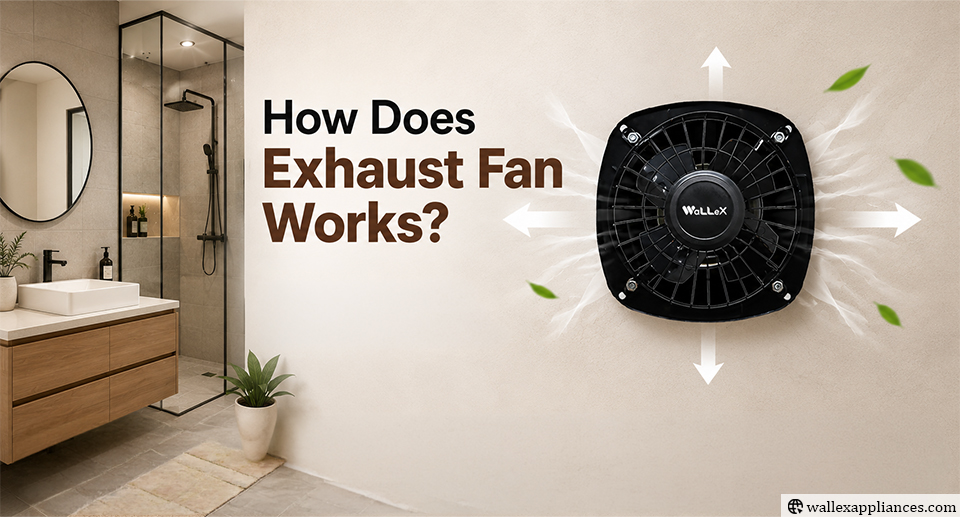
Hove you noticed you come out of the hot shower, and the bathroom is unclouded, your walls aren't sweating, and there is no stink or you are cooking onions at 7 P.M. and the kitchen doesn’t smell of onions when you are at breakfast. Such little moments of solace? The vast majority of people will attribute this to windows but the real hero is the exhaust fan steadily whirring in the corner.
They are things that we hardly think about, unless an emergency arises. Until they break. In this article we go into details about the use of exhaust fan, exhaust fan working principle and exhaust fan benefits.
An exhaust fan is a mechanical ventilation system that is used to remove stale, humid or contaminated air from an enclosed area to the outside environment. But most don't realize that it not only removes bad air, it creates a positive pressure that draws in fresh air to replace the bad air. The main component of exhaust fan is
Imagine that the bathroom is a box that is closed. It becomes filled with steam and humidity when every shower takes place in it. It’s an exhaust fan, which removes the box and replaces it with the dry, clean air in the house.
Read More: Exhaust Fan Installation
All exhaust fans have an electric motor with rotating blades (impeller). When the switch is turned on, the blades begin to rotate, creating a current of air streaming from the blades through a duct. When air is being ejected, the air pressure inside the room decreases slightly.
It's that drop in pressure that's the magic. When the pressure is high, the air will flow into lower pressure, which means that outside air will rush into the house to balance the pressure. It's a continuous process of stale air out, fresh air in.
CFM refers to the Cubic Feet per Minute (CFM), which indicates the rate of exchange of that fan. A bathroom should have about 1 CFM per square foot- size it right, and the whole system hums along without complaint.
The exhaust fan produces a negative air pressure inside of the room during operation. Air always moves toward the lower pressure areas. The principle of the exhaust fan does not involve pushing yourself on the job, it is about creating the conditions where fresh air will want to flow in.
Read More: Ventilation Fan vs Exhaust Fan
The advantages of exhaust fans come into their own with moisture control. Bathrooms without ventilation stay at 80–90% humidity for several hours after showering, which can lead to warped wood, peeling paint and rotten door frames. If the fan is used for 20 minutes after, that number is reduced significantly.
Mold prevention: It is a direct result of cleaning up. Clean-up is followed by mold prevention. Removing mold will cost much but running an exhaust fan, every day is simple and affordable.
Removing Odors: It is quite different from covering them up. The addition of molecules is performed using air fresheners. Exhaust fans replace the air totally—one covers the problem and the other eliminates it.
Clean, Healthy Air: People with asthma or allergies often experience symptoms long before they determine the source; the culprit is gases and fine particulate matter that accumulate in unventilated kitchens when cooking.
Kitchen: operating whenever you cook, as well as when it's smoking. Even boiling water releases moisture that slowly ruins walls and cabinets over months. This is not just comfort—it’s preservation.
Bathroom: Preheat water to temperature prior to shower, leave water running 15–20 minutes afterwards. The whole thing is automated with a $15 Timer Switch.
Home office: Elevated CO₂ from breathing in a closed room results in fatigue and brain fog. An exhaust fan with fresh air intake changes how the space feels within an hour of working.
Running Exhaust Fan During the Problem Rather Than After: Using the fan while taking a shower means that you only trap about 1/3 of the moisture created. Steam dissipates upon stepping out. It's much more important to run it after you shower.
Obstructing the Passage of Air: If the gap is covered by a thick rug, then the fan is operating a partial vacuum. It strains, moves less air and sounds fine while doing very little.
Not Cleaning the Grill: Dust clogged grills reduce the flow of air by 30-50%. An ideal vacuum is provided every few months, which makes a huge difference in performance.
Exhaust fans are not appreciated enough. However, when an exhaust fan is used correctly, in the right areas at the right time, it prevents structural and health damage that's much more costly than anyone would expect.
Next time you stroll into a bathroom that is not a sauna you should give the exhaust fan some credit.
Ans: Use it during and after activities that generate heat, moisture, smoke, or odors—like cooking or showering.
Ans: It pulls stale air out, creating slight negative pressure so fresh air flows in from outside.
Ans: Run it during use and for 15–20 minutes after, keep vents clean, and ensure proper airflow paths.
Ans: It can reduce heat buildup, but it doesn’t replace an air conditioner or cooler.
Ans: Choose based on room size (CFM rating); larger rooms need higher airflow capacity.