
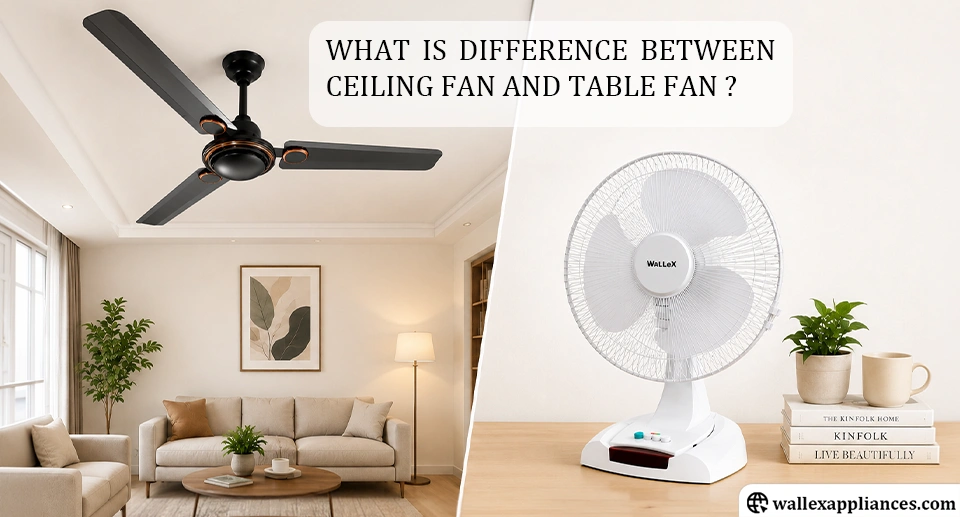
This is a dilemma every Indian household has to tackle every summer – whether to opt for a ceiling fan or invest in a table fan? The question of table fan vs ceiling fan is more complicated than it sounds, be the objective is about reducing your power bill, or just want to get a clean flow of air through the room.
Both types of fans circulate air, but in different ways and for different reasons — size of the room, ceiling height, cost and lifestyle. This article delves deep into all you need to know: how each fan operates, a head-to-head comparison of key parameters, a detailed analysis of how much power each type consumes. We will share some practical tips for each type of user.
A table fan is a portable, small electric fan that provides a specific direction of airflow typically into a particular area. It can be placed on any flat surface, such as a desk, kitchen counter or nightstand or on the floor, and all that's needed is to plug it into the power socket.
When switched on the table fan produces air flow with a motor fitted in the fan the magnetic field produced by the current and the permanent magnets in the housing of the motor produce rotational forces. This causes the fan blades to rotate, and then push the air in a concentrated stream forward. Most table fans also feature an oscillation function which allows the fan head to rotate from side to side to cover a wider range without having to swing the fan in a permanent direction.
Read more: Table Fan Wattage
A permanently attached electrical fan hanging from the ceiling of a room is called a ceiling fan. It is designed to evenly distribute air across the entire room, and is recommended for whole room cooling.
A ceiling fan is similar to a table fan, which uses electricity to create mechanical movement by means of a motor. The motor housing, however, is located above the room and the wide blades (usually 48 to 56 inches wide) spin horizontally. When the blades are whirling, they draw air down to create a column of air that is moving down and expands outwards once it reaches the floor, resulting in a continuous circulation throughout the room. In reverse, which can be used with many models, the blades force warm air from the ceiling in winter, too, and increase heating efficiency.
Read More: Ceiling Fan Wattage Explained
Ceiling Fan vs Table Fan tet us have a complete comparison of the two types of fans on all the key parameters.
|
Parameter |
Table Fan |
Ceiling Fan |
|
Installation |
No installation; plug and play |
Requires professional installation |
|
Portability |
Fully portable; room to room |
Fixed to ceiling; permanent |
|
Airflow Direction |
Outward / directional |
Downward, then outward (whole room) |
|
Coverage Area |
Small to medium (personal zone) |
Large (entire room) |
|
Cooling Efficiency |
High for targeted areas |
High for overall room comfort |
|
Average Power Consumption |
30–60 watts |
70–90 watts (standard); 25–35 watts (BLDC) |
|
Initial Cost |
Lower (₹800–₹3,000 approx.) |
Higher (₹2,500–₹8,000+ approx.) |
|
Installation Cost |
None |
₹300–₹700 (professional) |
|
Maintenance |
Easy; accessible without tools |
Needs ladder; periodic dusting |
|
Noise Levels |
Moderate to low |
Very low (especially BLDC models) |
|
Room Suitability |
Small rooms, desks, kitchens |
Bedrooms, living rooms, large halls |
|
Aesthetic Impact |
Functional; minimal design impact |
Significant; enhances room décor |
|
Lifespan |
5–8 years |
10–15 years |
Understanding table fan vs Ceiling fan power consumption is essential when attempting to control electricity invoice. A comparison of the energy consumption of both types of fans.
Table fans range in power from 30 to 60 watts, depending on size of blades, quality of motor and speed setting. Typical table fan 400mm (16"): 55-60 watts at full speed.
Conventional induction motor ceiling fans range from 70–90 watts. But, today's BLDC (Brushless DC) ceiling fans have turned the situation upside down, using only 25-35 watts, which is much more efficient than even most table fans.
A regular ceiling fan uses more electricity than a table fan. A ceiling fan consumes 70–90 watts of power on average while a table fan consumes 30–60 watts. In contrast, a modern BLDC ceiling fan is only 25-35 watts, which is less than the power usage of most table fans, and covers a much greater area.
The traditional model of ceiling fan features an induction motor that requires a comparatively high amount of current to keep the motor spinning. They have proportionately larger motors than table fans, and thus higher wattage, since they require air to circulate over a room.
Unlike resistive motors, BLDC motors employ permanent magnets and electronic commutation. This means that there is no loss of energy to heat in a conventional motor. The outcome is a motor with the same — or better — airflow on a reduced electrical consumption. A 5-star BLDC ceiling fan can save up to 65% of electricity compared to an ordinary ceiling fan.
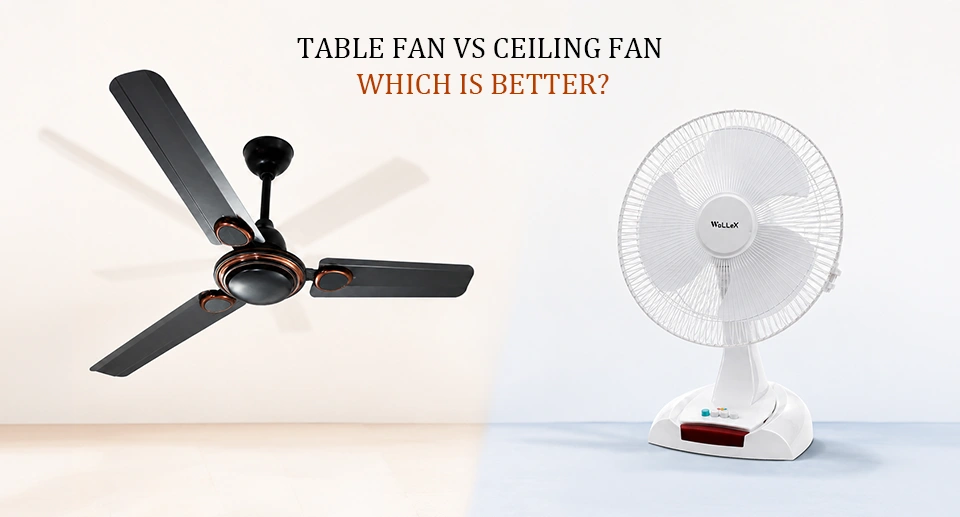
That will depend on your circumstances and requirements. Here is a clear guidance for some common situations:
For Small Rooms (Under 100 sq. ft.): A table fan will do and will be less expensive.
For Large Rooms (150–300 sq. ft.): Ceiling fans are the top choice as table fans are not effective in dispersing air out over a wide area.
For Bedrooms: A ceiling fan makes sleeping more comfortable as it circulates air at a steady speed, rather than the direct draft table fans create.
For Offices and Workstations: A table fan is best suited for this as it can give "directed" flow of air.
For Renters: Table fans are the effective option for renters as they are portable and no installation required.
For Energy Savings: BLDC ceiling fans provide maximum energy saving for the cooling amount.
For Targeted Cooling: Table fans win. The portable design and head that moves on a pivot allow them to direct airflow to where it's needed.
The table fan vs ceiling fan debate does not have a single winner — it has a right answer for each situation. Ceiling fans circulate air in a large area, and are perfect for larger rooms, while table fans circulate air in a smaller area or for personal use. Conventional ceiling fans consume more power than the table fans, in terms of electricity consumption. Today's BLDC ceiling fan models, however, use a lot less energy, and offer better room coverage as well. If affordability, flexibility, or spot cooling is desired, then a table fan is a better option.
A table fan will be enough in very small rooms where a table fan will cover.
Ans: It depends on your needs. Table fans are best for personal cooling, while ceiling fans are better for whole-room airflow.
Ans: Standard ceiling fans usually use more power than table fans. However, BLDC ceiling fans often consume less electricity while cooling a larger area.
Ans: Yes. A ceiling fan circulates air throughout the room, while a table fan provides targeted cooling where needed.
A table fan works well for very small rooms, while a ceiling fan is better for rooms requiring consistent airflow.
Ans: Yes. BLDC ceiling fans use up to 65% less electricity than conventional ceiling fans and operate more quietly.
Ans: Yes. A ceiling fan circulates air across the room, while a table fan provides targeted cooling for added comfort.